Severity: Warning
Message: opendir(/var/cpanel/php/sessions/ea-php56): failed to open dir: Permission denied
Filename: drivers/Session_files_driver.php
Line Number: 360
Backtrace:
File: /home/azista/public_html/bbold.world/application/controllers/Home.php
Line: 7
Function: __construct
File: /home/azista/public_html/bbold.world/index.php
Line: 316
Function: require_once
21 Nov, 2025
Acne can be frustrating, especially when you’ve tried every cleanser, toner, and moisturizer without lasting results. For stubborn or persistent acne, basic routines often aren’t enough. Upgrading to advanced acne solutions with proven ingredients can make a real difference.
Think of skincare like cooking biryani: even with the best ingredients, if the layers, timing, or technique aren’t right, the result won’t be perfect. Similarly, your skin needs ingredients that penetrate deeper, target inflammation, unclog pores, and support healing, not just sit on the surface.
How they work:
Best for: Moderate to severe acne or breakouts that don’t respond to basic cleansers.
Tip: Start with a lower concentration to minimise irritation. Use it at night and always apply sunscreen during the day.
How they work:
Best for: Sensitive skin or skin prone to redness. Can be used daily with minimal irritation.
How they work:
Best for: All skin types, especially oily or combination skin. Gentle enough for daily layering.
How they work:
Best for: Acne-prone and oily skin, especially clogged pores.
How they work:
Best for: All skin types, particularly dry or combination skin. Works perfectly alongside active acne treatments to prevent dryness.
Regular creams and gels often stay on the surface of your skin, which can limit how well active ingredients like Salicylic Acid and Hyaluronic Acid work. Microneedle patches solve this problem by delivering ingredients deeper into the skin.
Highlight: Using a Salicylic Acid + Hyaluronic Acid microneedle patch—like the BBold Dissolvable Microneedle Acne Patch—gives faster, more effective results than surface creams, making acne management simple and efficient.
When home-care ingredients aren’t enough, dermatologists may recommend:
A tiny patch, a gentle touch, a clearer you."Advanced ingredients like retinoids, azelaic acid, and niacinamide tackle acne at the source, while microneedle patches—including the BBold Dissolvable Microneedle Acne Patch—deliver Salicylic Acid and Hyaluronic Acid deep into the skin for faster, visible results. This targeted approach unclogs pores, helps heal pimples in hours, and prevents scarring, making stubborn acne simple and effortless to manage.
28 Jan, 2023
Acne is not as insignificant as it seems! It bags you trolls and tosses off your confidence and self-esteem. It is a botheration for both the young and the old generations today!
Acne is a common skin condition that occurs when the hair follicles become clogged with oil and dead skin cells. It typically appears on the face, neck, back, and chest. Acne often occurs during adolescence, and about 20% of the cases occur in adults. However, acne usually occurs during puberty between the ages of 10 - 14 and above and worsens in people with oily skin.
Certain reasons cause Acne and become a reason of worry. A few are:
In the human skin, the pores are connected to oil glands underneath, and follicles, or the small sacs that produce and secrete liquid, connect these glands to the pores, causing Acne to appear.
It starts with an increase in hormone production. Acne pops up person produces high levels of androgens, the male sex hormones that include testosterone. Testosterone signals the body to make more sebum, the oil produced in the skin's oil glands.
While women approach their period, their levels of estrogen and progesterone drop, causing the testosterone hormone to increase, causing the sebaceous glands to open, which produces sebum that fuels acne.
Excess sebum clogs the openings to hair follicles, especially on the face, neck, chest, and back. Bacteria tend to grow in these clogged follicles. At times, clogging may force the follicle wall to break, and the sebum falls into nearby tissues that form a pustule or a Papule called inflammatory acne.
Researchers state that you can get Acne if you have it in your genes (parents, grandparents, etc.).
Stress could be one of the reasons for skin problems.
Pollution, dry skin, high humidity can be the reasons.
There are several types of acne, including:
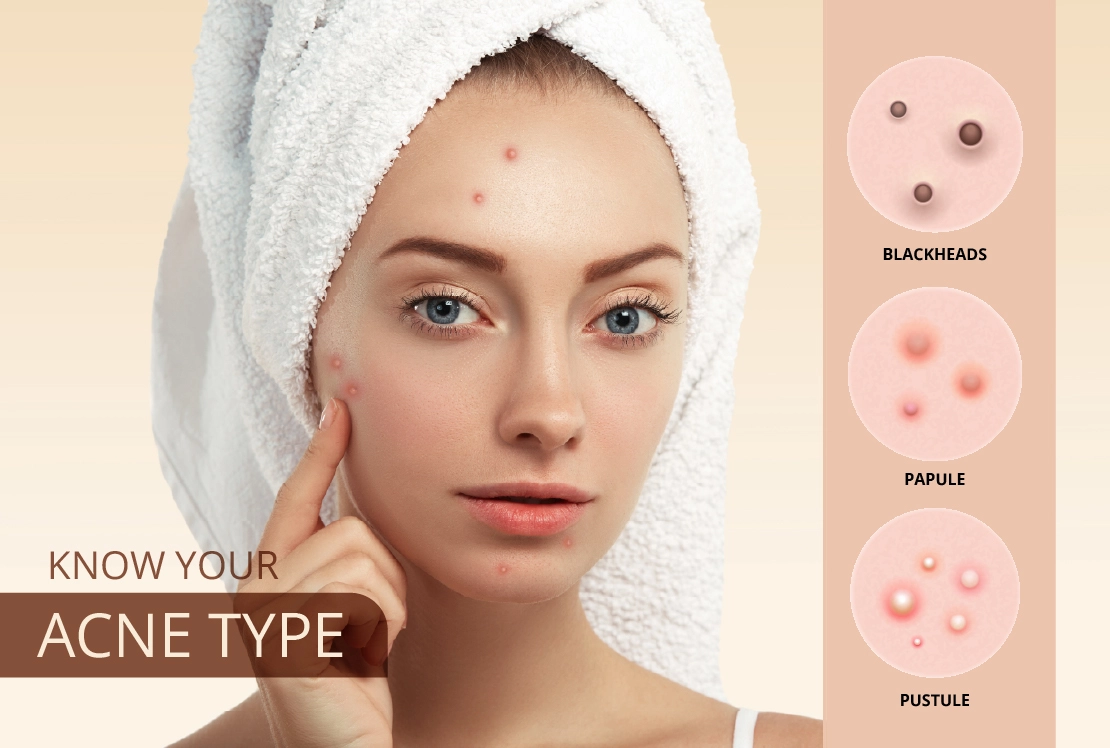
Blackheads: Blackheads are small, black bumps that appear on the skin when the hair follicles become clogged with oil and dead skin cells.
Whiteheads:Whiteheads are similar to blackheads, but they are covered by a layer of skin, giving them a white or skin-colored appearance.
Papules:Papules are small, red bumps that are tender to the touch and can be painful.
Pustules: Pustules are similar to papules, but they contain pus and are more visible.
Nodules: Nodules are large, hard bumps that develop deep within the skin and are often painful.
Cysts: Cysts are large, pus-filled lesions that are painful and can lead to scarring if they burst.
Treatment for acne may include over the counter or prescription topical medications, oral medications, or a combination of these approaches. It is important to speak with a dermatologist or healthcare provider to determine the best treatment plan for your specific needs.
There are several treatment options available for acne, including:
It is important to speak with a dermatologist or healthcare provider to determine the best treatment plan for your specific needs. Some treatments may work better for certain types of acne, and certain treatments may not be suitable for all skin types.
Read More
16 Jan, 2023
Biological and gender factors largely drive health differences between men and women. Most of the time, women spend much time helping others, ignoring themselves while women indeed need self-care and concern the most, for their well-being.
Dear women! Self-care should be your priority for a healthy body besides everything! So, we say understand your self-care needs and ways to address them.
Self-care is personal hygiene that women should emphasize as a routine in their lifestyle which also includes intimate hygiene.
Personal hygiene is an important aspect of maintaining good health and well-being. It involves regularly washing the body, brushing the teeth, keeping the hair clean and well-groomed. It also involves wearing clean clothes, washing your hands frequently, and practicing good genital/intimate hygiene.
Personal hygiene is crucial to balance your body and mind. Experts say a healthy vagina contributes to your overall health.
Poor personal hygiene in women can lead to several health problems, including:
Vaginal infections: Poor genital hygiene can lead to an overgrowth of bacteria or yeast, which can cause infections such as bacterial vaginosis or thrush.
Urinary tract infections: Wiping from back to front after using the washroom and not washing hands before and after can lead to bacteria entering the urinary tract and causing an infection.
Skin irritation: Not washing the genital area regularly can lead to the build-up of sweat, oil, and bacteria, which can cause irritation and itching.
odour: Poor genital hygiene can lead to an unpleasant odour emanating from the genital area.
Reproductive health issues: Neglecting personal hygiene can also lead to issues with reproductive health, such as sexually transmitted infections.
It is important to practice good personal hygiene to maintain overall health and well-being. This includes washing the genital area regularly with a gentle, pH-balanced cleanser intimate wash of good quality, changing tampons and pads frequently during menstruation, and wearing clean, breathable underwear.
Read More